
introduction
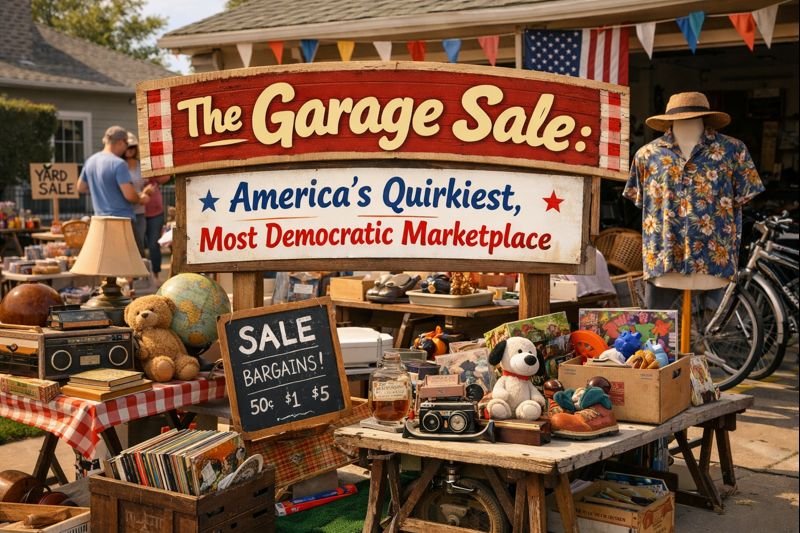
On a Saturday morning, in a suburban neighborhood somewhere across the country, a familiar ritual unfolds. Card tables sag under the weight of mismatched china. A child’s outgrown bicycle leans against a garage door. Racks of clothing, carrying the faint, universal scent of attics and mothballs, sway in the gentle breeze. A hand-lettered sign, taped to a telephone pole, points the way with an arrow. The garage sale is in session—a sprawling, chaotic, and profoundly human ecosystem of commerce, memory, and community that offers a unique window into the American soul.
More than a mere method of decluttering, the garage sale is a cultural institution. It is a temporary, hyper-localized economy that operates on its own rules. Here, the laws of retail are suspended. There are no algorithms determining “frequently bought together” items, no sterile showrooms, and no fixed prices, only hopeful opening bids scrawled on neon stickers. It is a marketplace built entirely on negotiation, curiosity, and the serendipitous discovery of a treasure amid what others have deemed trash.
The psychology of the seller is a tapestry of liberation and nostalgia. The act of dragging boxes from the basement and spreading one’s personal history across a driveway is an exercise in catharsis. It is a physical reckoning with accumulated stuff—each chipped mug, each paperback thriller, each unused bread machine representing a past intention, a forgotten hobby, or a chapter of life now closed. Pricing an item at fifty cents is less about recouping its value and more about assigning a token fee for its liberation. The seller isn’t just making a few dollars; they are making space, both literally in their home and metaphorically in their mind. They are passing on a story, often volunteering its history to a interested buyer: “This vase came from my grandmother’s house in Ohio,” or “My son built this birdhouse in Cub Scouts.” The transaction becomes a transfer of narrative.
For the buyer, the garage sale is a hunt. It is the antithesis of the big-box store experience. This is not about finding a specific, mass-produced thing, but about the thrill of the unknown. The dedicated “salers,” coffee in hand, map their routes from circled ads, are driven by a potent mix of frugality, environmental consciousness, and the collector’s lust. They are archaeologists of the recent past, sifting through layers of 90s knick-knacks, 70s polyester, and mid-century furniture waiting for a new coat of paint. The value is not inherent but imputed. A tacky tourist plate is kitsch. A first-edition novel is a find. A solid oak dresser, buried under a pile of stuffed animals, is a victory. The garage sale democratizes taste, proving that one person’s eyesore is another’s centerpiece.
Beneath the surface of this casual commerce lies a powerful economic and ecological statement. In an age of fast fashion and disposable goods, the garage sale is a monument to reuse. It is the purest form of recycling, keeping perfectly functional items out of landfills and circulating them within a community. It subverts the endless cycle of new consumption, offering a second, third, or fourth life to objects. Economically, it represents a people’s capitalism—a low-barrier, cash-based economy where anyone can be both merchant and customer. It is a tangible lesson in supply and demand, where the value of a power drill plummets at 3 PM as the seller’s desire to be done with the day outweighs their desire for an extra five dollars.
Perhaps the most significant, yet most intangible, product sold at a garage sale is community. In an era of digital isolation and curated social media feeds, the garage sale forces real, unscripted interaction. Neighbors who might only wave from their cars stop to chat over a box of old records. Strangers bond over a shared appreciation for Pyrex bowls or vintage tools. The conversations are meandering and personal: bargaining tips over a lamp’s price lead to discussions about home decor, which lead to recommendations for a local electrician. It is a temporary commons, creating a web of low-stakes, friendly connections that strengthens the social fabric of a neighborhood. Children learn the basics of commerce by setting up a lemonade and toy stand, their earnest faces a reminder of the sale’s foundational simplicity.
The garage sale is also a living museum of late-20th and early-21st century material culture. A single sale can chronicle a family’s journey: the plastic baby toys, the chapter books of adolescence, the formal wear of weddings, the tools of DIY projects, and the comforting clutter of a lifetime. Walking down a driveway is like walking through a decade. Here is the avocado-green appliance of the 1970s, there the neon spandex of the 1980s, and over there the boy-band memorabilia of the 1990s. It is an unintentional archive, preserving the ordinary artifacts that official history forgets. Future anthropologists would learn more about daily American life from a well-documented garage sale than from a dozen history textbooks.
Of course, the tradition faces modern pressures. The digital world has co-opted and streamlined its chaos. Facebook Marketplace and Nextdoor offer year-round, weather-proof selling, while apps like OfferUp facilitate contactless pickup. The curated aesthetic of sites like Etsy has professionalized the market for vintage goods, often stripping away the local, haphazard charm. Yet, despite these digital rivals, the physical garage sale endures. Why? Because the algorithm cannot replicate the experience. It cannot provide the satisfaction of rummaging through a box to find the perfect, unexpected item. It cannot replicate the smell of old paperbacks in the sun, the sound of a haggling conversation, or the simple pleasure of a Saturday morning spent outdoors on a quest.
The garage sale, in the end, is a celebration of impermanence and rediscovery. It acknowledges that our possessions are temporary companions on our journey. It provides a dignified exit for the objects that have served their purpose for us, and a hopeful entrance for someone new. It is a testament to the idea that everything has a story, and every story can find a new listener. So next time you see those handwritten signs, follow the arrows. You might just find a $5 treasure, have a delightful conversation with a stranger, and participate in a uniquely American ritual that is equal parts economics, ecology, and humanity—all from the humble concrete stage of a driveway.