
introduction
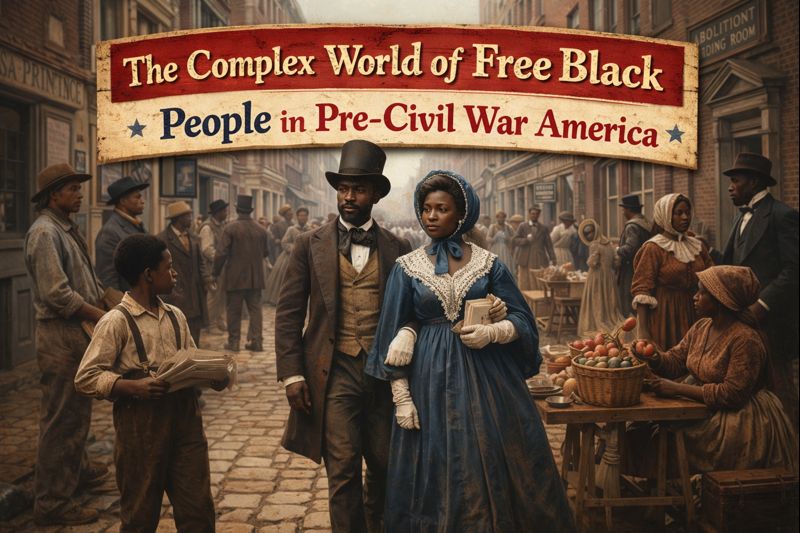
The history of Black people in America is often told as a journey from slavery to freedom, with emancipation during the Civil War as the defining turning point. However, this narrative overlooks the nuanced and significant reality of hundreds of thousands of free Black individuals who navigated a precarious existence long before the 1860s. This article explores their origins, daily lives, regional experiences, and complex legacy, offering a fuller picture of Black history in America.
1. Origins and Paths to Freedom
The free Black population emerged from several distinct pathways throughout the colonial and antebellum periods. Their existence was a constant anomaly in a society built on racialized slavery.
- Early Colonial Foundations: A class of free Black people existed in North America as early as the 17th century. According to historical records, their status could originate from being the descendants of free Black women, as children typically inherited the legal status of their mother. Others were the mixed-race children of white indentured servants or free women, who were born free.
- Manumission and Self-Purchase: A primary path to freedom was manumission, where an enslaver granted freedom, sometimes in a will as a reward for long service or to free their own children born to enslaved women. In some cases, particularly in urban areas, enslaved people could negotiate to purchase their own freedom or that of family members through skilled labor done outside their normal duties, a practice known as “hiring out.”
- The Revolutionary War Catalyst: The American Revolution (1775-1783) profoundly impacted the free Black population. The rhetoric of liberty prompted many slaveholders, especially in the Upper South, to free their slaves. Furthermore, both British and American forces offered freedom in exchange for military service. This period saw a dramatic increase; while free Black people made up about 5% of the total Black population at the start of the Revolution, that proportion rose to over 13% by 1810.
- By the Numbers: On the eve of the Civil War, the 1860 U.S. Census recorded 488,070 free Black individuals in a total Black population of nearly 4.5 million. Notably, a majority of these free people—approximately 261,000—lived in the slaveholding states of the South.
2. Life in the “Free” World: Rights and Restrictions
Freedom for Black Americans before the Civil War was a relative term, defined more by what it was not (slavery) than by equality with white citizens. Their liberty was consistently constrained by law and custom.
- Legal Vulnerability: A free Black person’s most important possession was their official “free papers”—documents proving their legal status. Without them, they risked being kidnapped and sold into slavery, with little legal recourse. Black sailors, or “Black Jacks,” who worked on merchant vessels, carried special protection papers called “Seamen’s Protection Certificates” to prove their freedom when in Southern ports, though these were often ignored.
- Systemic Discrimination: “Black Laws” or “Black Codes” in both the North and South severely limited their rights. Common restrictions included:
- Denial of Voting Rights: With few exceptions, free Black men were barred from voting.
- Limits on Movement: Some states required free Black people to register annually and carry their papers, and others tried to force newly freed individuals to leave the state.
- Judicial Inequality: They were often barred from testifying in court against a white person, making it nearly impossible to seek justice for crimes committed against them or their property.
- Economic Barriers: Licenses for certain trades were restricted, and access to public education was limited or nonexistent.
- Building Community Institutions: In response to exclusion, free Black communities built their own robust institutions. The Black church became the central pillar—not just for worship, but as a hub for schooling, mutual aid, and political organizing. The African Methodist Episcopal (A.M.E.) church, founded by Richard Allen and Absalom Jones in Philadelphia after facing segregation, is a prime example. Fraternal orders, beneficial societies, and schools were also established to provide support and advancement.
3. Regional Variations: North vs. South
The experience of free Black people varied dramatically depending on geography, influenced by local economies and social structures.
- The Northern States: While slavery was gradually abolished in the North after the Revolution, racial prejudice was entrenched. Free Black Northerners faced pervasive social segregation, job discrimination, and the constant threat of anti-Black mob violence, as seen in destructive riots in cities like Philadelphia and New York. Their communities, however, often had slightly greater freedom to organize, leading to the establishment of the first Black newspapers like Freedom’s Journal (1827) and the founding of the American Anti-Slavery Society by Black leaders.
- The Upper South: In states like Maryland, Virginia, and Delaware, free Black communities were often large and long-established, with deep family roots. However, as the 19th century progressed and the slavery-based economy felt pressure, these states passed increasingly repressive laws. They feared that free Black people undermined the institution of slavery, leading to efforts to curtail manumissions and even force free Black people to emigrate to Africa or other states.
- The Deep South: Here, free Black people were a smaller minority within a society deeply committed to plantation slavery. In some areas, like South Carolina, laws were exceptionally harsh. The unique exception was Louisiana, particularly New Orleans. Under earlier French and Spanish rule, a distinct three-caste society developed among whites, free people of color (gens de couleur libres), and slaves. The free people of color in New Orleans, many of whom were wealthy, educated, and owned property (some even owned slaves themselves), formed a sophisticated, culturally vibrant community that defied the broader Southern binary.
4. Identity, Activism, and the Shadow of Slavery
The identity of free Black people was complex and their political stance was unequivocal: they were the vanguard of the abolition movement.
- A Dual Consciousness: They lived with a dual reality—experiencing personal liberty while being intimately connected to the enslaved community through family ties and shared racial oppression. This positioned them as critical bridges and advocates.
- Leadership in Abolition: Prominent free Black figures were the backbone of the fight against slavery. Frederick Douglass (born into slavery but escaped to freedom), David Walker (who wrote the fiery Appeal to the Colored Citizens of the World), and Maria Stewart (a pioneering public speaker) used their voices and presses to demand immediate emancipation and full citizenship rights.
- The “Back to Africa” Question: Faced with persistent oppression, some free Black leaders, like Paul Cuffe, and later, proponents of the American Colonization Society, advocated for emigration to Africa, leading to the founding of Liberia. This idea, however, was fiercely opposed by the majority of free Black people and abolitionists, who declared America their home and insisted on fighting for their rights here. National Colored Conventions, held regularly from 1830 onward, were a key forum for debating these strategies and unifying political demands.
5. The Civil War and the End of an Era
The Civil War (1861-1865) fundamentally transformed the meaning of freedom for all Black Americans.
- A War for Union Becomes a War for Freedom: Initially, the Union fought to preserve the nation, not to end slavery. Free Black communities and abolitionists pressured President Lincoln relentlessly. The Emancipation Proclamation (1863) was a strategic and moral turning point, declaring slaves in rebel states free and, crucially, authorizing the enlistment of Black soldiers.
- Service and Sacrifice: Nearly 200,000 Black men, many of them free Northerners, served in the United States Colored Troops (USCT). Their bravery on the battlefield and service as scouts, laborers, and nurses was a powerful argument for citizenship. As one free-born soldier put it, they were fighting to “make this a government of the people, the whole people.“
- From Contingent Freedom to Universal Emancipation: The war’s end and the ratification of the Thirteenth Amendment (1865) finally abolished slavery nationwide. This marked the end of the distinct legal category of “free people of color.” Overnight, four million enslaved people joined their previously free brethren in a shared, though still perilous, legal status of freedom.
Conclusion
The history of free Black people before the Civil War is not a sidebar to the story of American slavery; it is central to understanding the long, continuous struggle for Black liberation. They demonstrated that freedom could exist, however imperfectly, alongside slavery, and they tirelessly worked to expand that freedom for all. Their legacy is found in the institutions they built—the churches, schools, and newspapers that would become the foundation of Black community life after emancipation. Their fight for dignity, equality, and justice against staggering odds established the blueprint for the civil rights movements that would follow, reminding us that the quest for true freedom is a relentless and ongoing journey.