
Introduction
The Millennium Dome Greenwich London is one of the most iconic landmarks in the United Kingdom. Originally built to celebrate the turn of the new millennium, the Dome was designed as a symbol of Britain’s innovative spirit, cultural diversity, and forward-looking vision. Over the years, it has transformed from a controversial government project into a world-class entertainment venue now known as The O2 Arena.
This article explores the history, design, cultural significance, controversies, and modern role of the Millennium Dome, making it a must-read guide for anyone interested in London’s architectural wonders and tourist attractions.
History of the Millennium Dome
Origins and Purpose
The Millennium Dome was conceived in the late 1990s as a grand project to celebrate the year 2000. The British government envisioned it as a futuristic structure that would symbolize optimism for the new millennium.
- Project launch: 1994 under Prime Minister John Major
- Development accelerated: 1997 under Tony Blair’s government
- Objective: Host the Millennium Experience, a year-long exhibition showcasing Britain’s achievements in science, technology, culture, and art.
Opening and the Millennium Experience
The Dome officially opened on December 31, 1999, in a spectacular ceremony attended by Queen Elizabeth II and world leaders.
The Millennium Experience exhibition included themed zones covering topics such as:
- The Body Zone (human biology)
- The Mind Zone (creativity and innovation)
- The Faith Zone (religion and spirituality)
- The Home Planet Zone (environment and sustainability)
Although millions of people visited, the project soon became controversial due to high costs and mixed reviews.
Architectural Design of the Dome
Structure and Dimensions
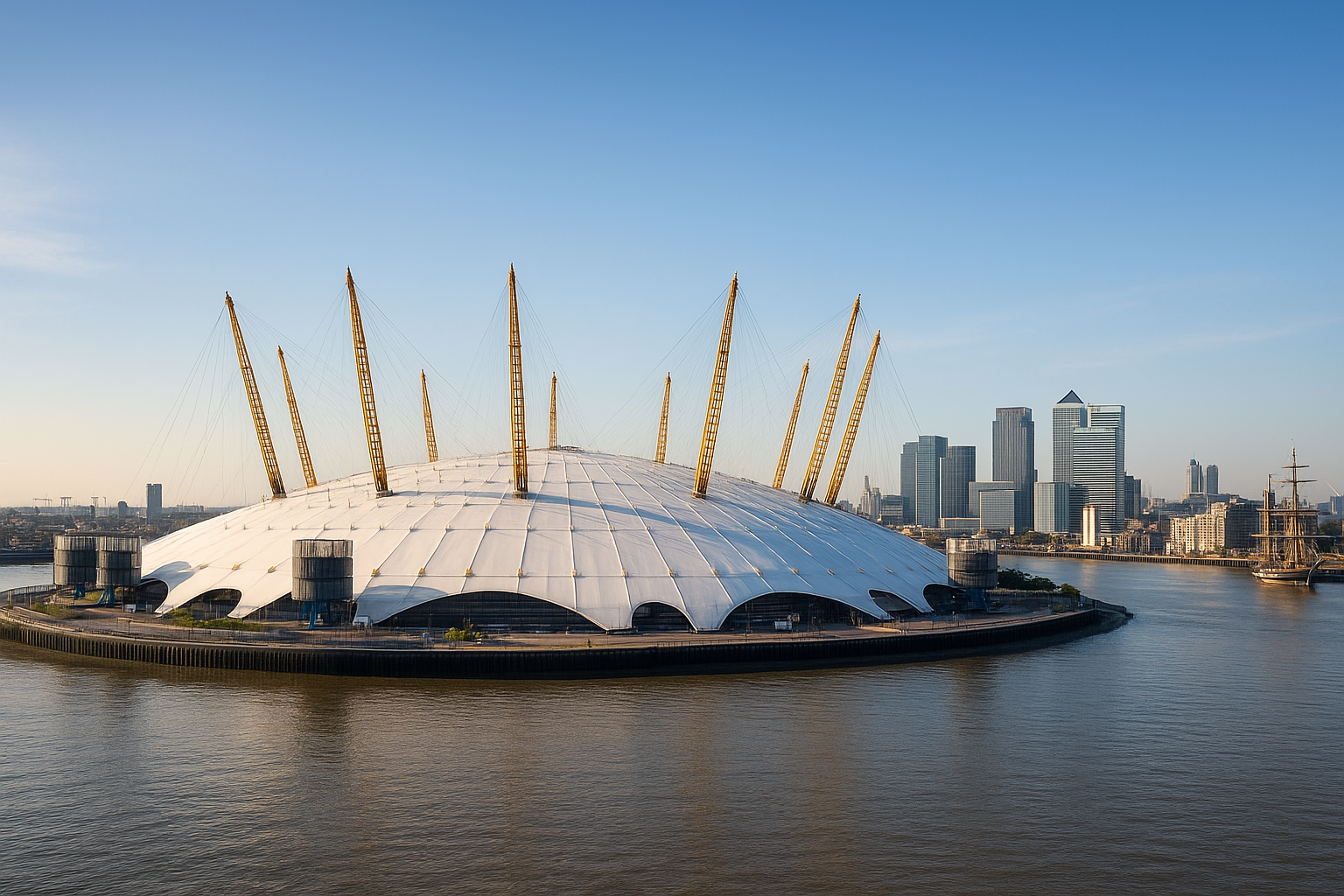
The Millennium Dome is not a traditional building but rather a giant tensioned fabric structure.
- Diameter: 365 meters (one for each day of the year)
- Height: 52 meters (symbolizing weeks in a year)
- Material: PTFE-coated fiberglass fabric stretched over steel cables
- Support: 12 yellow towers (representing months of the year or hours of a clock)
This symbolic design reflects the passage of time, fitting for a millennium celebration.
Location in Greenwich
Situated on the Greenwich Peninsula, the Dome occupies a historically significant site. Greenwich is home to the Prime Meridian Line and the Royal Observatory, linking the Dome to themes of time, space, and navigation.
Controversies and Criticism
Despite its bold design, the Dome faced public and political criticism.
- High costs: The project exceeded its budget, costing over £700 million.
- Public funding concerns: Taxpayers questioned whether the investment was justified.
- Low visitor numbers: Although expected to attract 12 million visitors, only around 6.5 million attended during 2000.
- Mixed reviews: Some praised the futuristic design, while others saw it as underwhelming.
The Dome became a symbol of government overspending for some critics, but its long-term transformation changed public perception.
Transformation into The O2 Arena
Sale and Redevelopment
After the Millennium Exhibition closed in 2001, the Dome stood largely unused. Eventually, in 2005, a private consortium led by the entertainment group AEG acquired the site.
They redeveloped the Dome into a world-class entertainment complex, reopening in 2007 as The O2 Arena.
Features of The O2
The redevelopment turned the space into:
- The O2 Arena (concert venue): 20,000-seat indoor arena for music, sports, and live events.
- Cineworld IMAX Cinema
- Indigo at The O2 (smaller music venue)
- Bars, restaurants, and shops
- Up at The O2 (roof climb experience)
This transformation made it one of the busiest entertainment venues in the world.
The O2 Arena: Cultural Significance
Music and Entertainment
The O2 has hosted global superstars such as:
- Beyoncé
- Elton John
- The Rolling Stones
- Adele
- Ed Sheeran
It is ranked as one of the most popular concert venues worldwide by ticket sales.
Sports Events
The venue also hosts major sports events, including:
- NBA and NHL games
- Tennis ATP Finals (2009–2020)
- Boxing matches
- Gymnastics competitions
This versatility adds to its global appeal.
Tourism and Visitor Experience
Accessibility
The Millennium Dome/The O2 is easily accessible:
- By Underground: North Greenwich Station (Jubilee Line)
- By River: Thames Clippers boat services
- By Road: Major road links and parking facilities
Things to Do at The O2
Visitors can enjoy:
- Concerts and live performances
- Dining at world-class restaurants
- Watching movies in IMAX quality
- Experiencing the Up at The O2 climb with panoramic views of London
Local Attractions
Nearby attractions include:
- The Royal Observatory Greenwich
- The Cutty Sark (historic ship)
- Greenwich Market
- Greenwich Park
Economic and Cultural Impact
Job Creation
The redevelopment into The O2 created thousands of jobs in entertainment, retail, and hospitality.
Tourism Boost
It significantly boosted London’s tourism industry, drawing millions of visitors annually.
Revitalization of Greenwich Peninsula
The Dome project contributed to the regeneration of the Greenwich Peninsula, turning it into a thriving cultural and residential hub.
Fun Facts About the Millennium Dome
- The Dome is one of the largest structures of its kind in the world.
- It could fit the Great Pyramid of Giza inside its space.
- It has hosted events such as the 2012 London Olympics gymnastics and basketball finals.
- The Dome’s roof fabric is strong enough to withstand extreme weather conditions.
The Dome in Popular Culture
The Millennium Dome has appeared in movies, music, and media, including:
- James Bond film “The World Is Not Enough” (1999) – opening scene features a boat chase near the Dome.
- TV shows and documentaries showcasing London’s modern architecture.
- Numerous music videos and live concert recordings.
Future of the Millennium Dome / The O2
The O2 continues to evolve with new expansions, digital innovations, and sustainability initiatives. With its prime location and cultural significance, it is set to remain a key part of London’s identity for decades to come.
Future plans include:
- More eco-friendly construction and energy use.
- Integration of smart technologies for events.
- Expansion of leisure and retail offerings.
Conclusion
The Millennium Dome Greenwich London has undergone a remarkable journey—from being a controversial government project to becoming The O2 Arena, one of the most visited entertainment venues in the world.
Its unique architecture, cultural symbolism, and modern transformation make it a fascinating landmark that reflects both Britain’s past ambitions and its dynamic future.
Today, the Dome stands not only as a reminder of the millennium celebrations but also as a global hub for music, sports, and tourism—a true icon of modern London.