
Introduction
The G8 member nations have long played a vital role in shaping the global economy, politics, and security frameworks. Formed as a forum for the world’s most industrialized nations, the Group of Eight has influenced decisions on trade, energy, climate change, and international security. Whether you are a student, researcher, or simply curious about international affairs, understanding the G8 countries gives you insights into how global governance works.
In this guide, we’ll explore the G8 member nations, their history, objectives, global impact, and frequently asked questions for a complete understanding.
What is the G8?
The Group of Eight (G8) is a political and economic forum consisting of some of the world’s largest advanced economies. While it was initially created as the G6 in 1975, it expanded over time to include eight members.
Key Characteristics of the G8
- A forum for dialogue on global economic and political issues.
- Represents leading industrialized democracies.
- Focuses on cooperation rather than binding decisions.
- Hosts annual summits where leaders discuss urgent global challenges.
List of G8 Member Nations
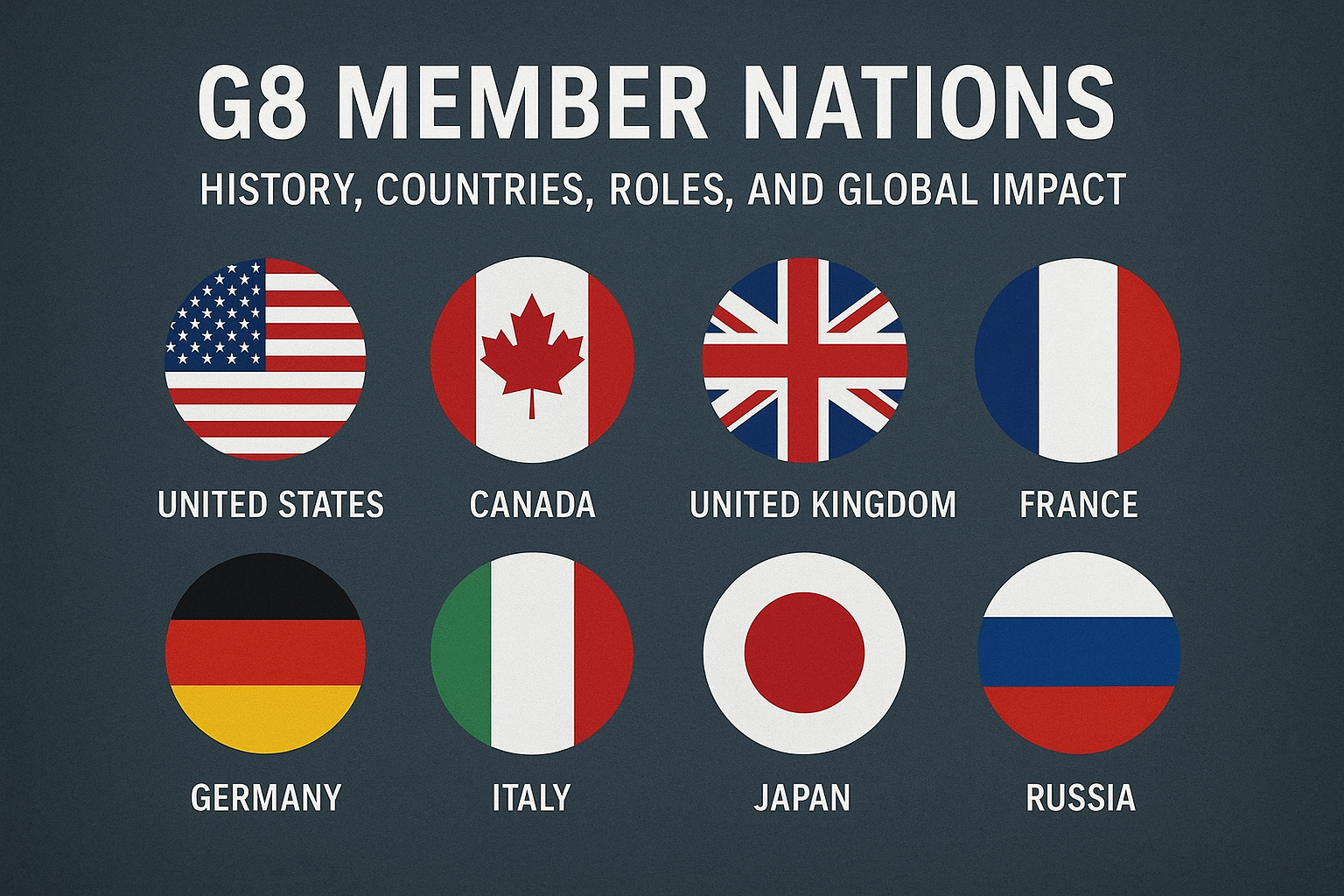
The G8 consists of eight powerful economies. Here’s the complete list:
- Canada
- France
- Germany
- Italy
- Japan
- Russia (suspended since 2014, making it functionally the G7)
- United Kingdom (UK)
- United States (US)
A Brief History of the G8
- 1975: Formation as the G6 (France, Germany, Italy, Japan, UK, US).
- 1976: Canada joined, making it the G7.
- 1997: Russia was added, expanding to the G8.
- 2014: Russia was suspended following the annexation of Crimea, reverting active operations to the G7.
Despite Russia’s suspension, the term “G8” is still often used, especially when referring to historical or structural aspects.
Profiles of Each G8 Member Nation
1. Canada
- Known for its natural resources and strong banking sector.
- Plays a significant role in energy and environmental discussions.
2. France
- A major European power with influence in global diplomacy.
- Key player in defense, nuclear energy, and cultural affairs.
3. Germany
- Europe’s largest economy.
- Leader in engineering, manufacturing, and renewable energy.
4. Italy
- Recognized for its manufacturing industries, fashion, and cultural heritage.
- Influential in Mediterranean and European Union affairs.
5. Japan
- A technological powerhouse.
- Contributes heavily to discussions on innovation and global finance.
6. Russia
- Known for energy exports, military strength, and vast geography.
- Currently suspended from active G8 participation.
7. United Kingdom
- A financial hub with global political and cultural influence.
- Plays a critical role in trade and security issues.
8. United States
- The largest economy and military power.
- Central in shaping global trade, defense, and international policies.
Objectives of the G8 Member Nations
The G8 focuses on issues of global importance. Their objectives include:
- Strengthening the global economy.
- Promoting democracy and good governance.
- Addressing climate change and sustainability.
- Enhancing international security and counter-terrorism.
- Supporting global health initiatives.
G8 vs. G7: What’s the Difference?
- G7: Excludes Russia (Canada, France, Germany, Italy, Japan, UK, US, and the EU as a participant).
- G8: Includes Russia but is currently inactive in this format.
Essentially, today’s active grouping is the G7, but discussions about the G8 member nations remain important historically and politically.
Achievements of the G8 Member Nations
Some notable accomplishments include:
- Coordinated responses to global financial crises.
- Agreements on reducing greenhouse gas emissions.
- Debt relief for developing countries.
- Joint efforts against terrorism and nuclear proliferation.
Criticism of the G8
While influential, the G8 faces criticism:
- Lack of representation from developing nations.
- Decisions are not legally binding.
- Seen as an elite club of wealthy countries.
- Overshadowed by newer forums like the G20.
G8 and the G20: How Do They Compare?
- G8: Focuses on major industrialized democracies.
- G20: Includes both developed and emerging economies (like China, India, and Brazil).
- The G20 is now considered more representative of the global economy.
Why the G8 Still Matters
Despite criticism, the G8 member nations remain influential because:
- They control a significant share of global GDP.
- They set agendas for larger forums like the G20.
- Their annual summits attract worldwide attention and policy discussions.
Frequently Asked Questions (FAQs) About G8 Member Nations
1. What are the G8 member nations?
The G8 includes Canada, France, Germany, Italy, Japan, Russia (suspended), the UK, and the US.
2. Is Russia still part of the G8?
Russia is suspended since 2014, so current operations function as the G7.
3. What is the difference between G7 and G8?
The G7 excludes Russia, while the G8 includes it. However, only the G7 is active today.
4. Why was Russia suspended from the G8?
Russia was suspended in 2014 after annexing Crimea, which violated international law.
5. Does the G8 still exist?
Yes, structurally it exists, but in practice, it functions as the G7.
6. What issues do G8 summits usually cover?
They cover global economics, trade, climate change, health crises, and security.
Conclusion
The G8 member nations have been central in shaping the global order for decades. From economic policies to climate change discussions, their influence cannot be ignored. While the G7 is the active version today, the G8 framework remains an important part of international diplomacy and history.
Understanding the G8 helps you grasp how world powers collaborate, negotiate, and sometimes clash over key global challenges.